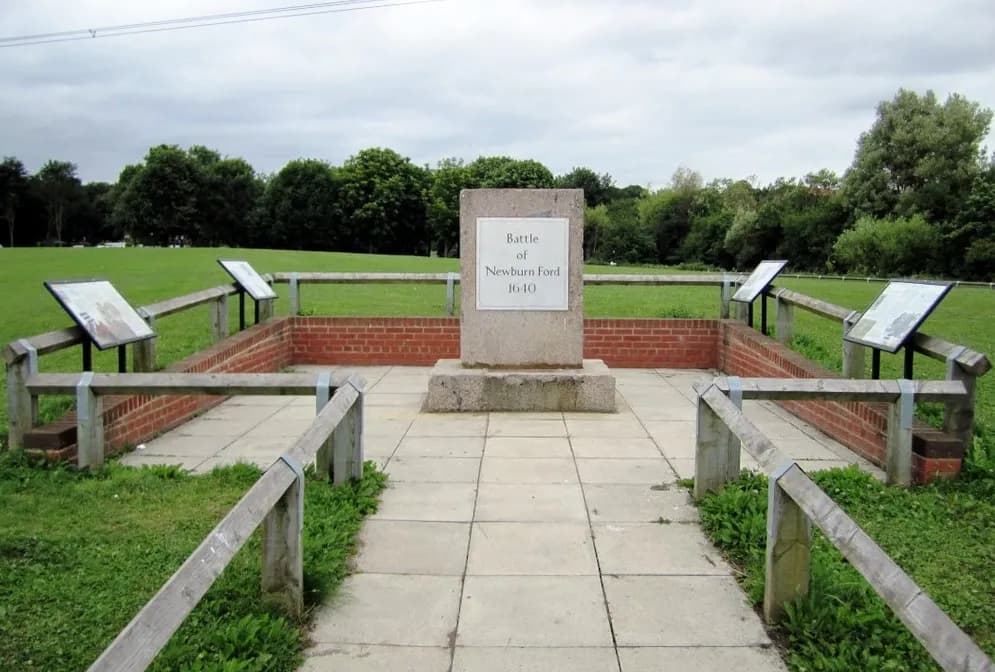
On 28 August 1640, a Scottish army crossed the River Tyne at a ford on Blaydon soil and routed the English forces defending it. The victory at what became known as the Battle of Stella Ford, or Newburn Ford, obliged King Charles I to recall Parliament for the first time in eleven years, setting in motion the events that led to civil war.
A Religious Dispute Spills onto Blaydon Soil
By the summer of 1640, King Charles I's attempt to impose Anglican practices on the Scottish Kirk had already sparked one war. The failure of the first Bishops' War in 1639 left the king determined to crush the Scottish Covenanters, who resisted his religious reforms. In August 1640, a Scottish Covenanter army of roughly 20,000 men commanded by Alexander Leslie crossed the border and advanced south towards the River Tyne.
The Engagement at the Ford
On 28 August 1640, the Scots reached a ford over the Tyne four miles west of Newcastle, in the Blaydon area. An English force of about 5,500 men under Lord Conway stood ready to defend the crossing. The English troops were ill-disciplined and mutinous. The Scottish forces attacked, broke through the English defence, and secured the ford. They then pressed on to occupy Newcastle, which they held for almost a year.
Financial Ruin and the Recall of Parliament
The defeat at Stella Ford left Charles I unable to dislodge the Scots from Northumberland and County Durham. The occupying Scottish army required £200,000 to withdraw, a sum the king could not raise without parliamentary taxation. Compelled to seek funds, he recalled the English Parliament for the first time since 1629, ending the period later known as the Eleven Years' Tyranny. This assembly, the Long Parliament, would go on to dismantle many of his powers and ultimately trigger the English Civil War.
A Local Legacy
Today, a monument near the site of the ford marks the engagement and Blaydon's place in a pivotal national moment. What began as a fight on the banks of the Tyne reshaped the government of England and confirmed the Covenanters' control of Scotland.